

Nearmap
Nearmap had spent more than a decade serving customers through highly customised, sales-led contracts. The company was moving toward simpler subscriptions and self-service, but the existing customer base couldn’t simply be switched over.
Pricing, renewal and access all behaved differently in the new model. For existing customers, a poorly handled transition could mean losing access or renewing onto terms they didn’t expect. For new customers, Nearmap needed to work out who could genuinely self-serve and who still needed sales support.
My role
I joined with parts of the transition already defined commercially but plenty still unresolved in the product. Over two periods (March – August 2024 and May – November 2025), I owned the subscription transition design: how existing accounts moved, how admins prepared access before pricing changed, and how new customers would enter later.
Product and Engineering were my day to day partners, with Legal reviewing the work. A lot of the job was getting us to agree on what should actually happen in the edge cases.
Moving existing customers safely
Existing customers were tied to a legacy subscription that did not map cleanly onto the new one. Renewal, access and usage all worked differently. There was no neutral path: a customer could move to the new model, stay on the old one under different terms, or leave. Doing nothing wasn’t neutral. Inaction itself triggered a defined outcome.
This had to hold across Australia and the US, and across account sizes and legacy configurations that didn’t translate one for one.
Assisted digital migration
The central problem was auto-renew. What happened next depended on whether auto-renew was on or off. Doing nothing could mean unintended churn or silently renewing onto the new pricing.
Unlike a normal upgrade, some of these decisions weren’t easily reversible. Customers needed to understand the consequence before they confirmed.
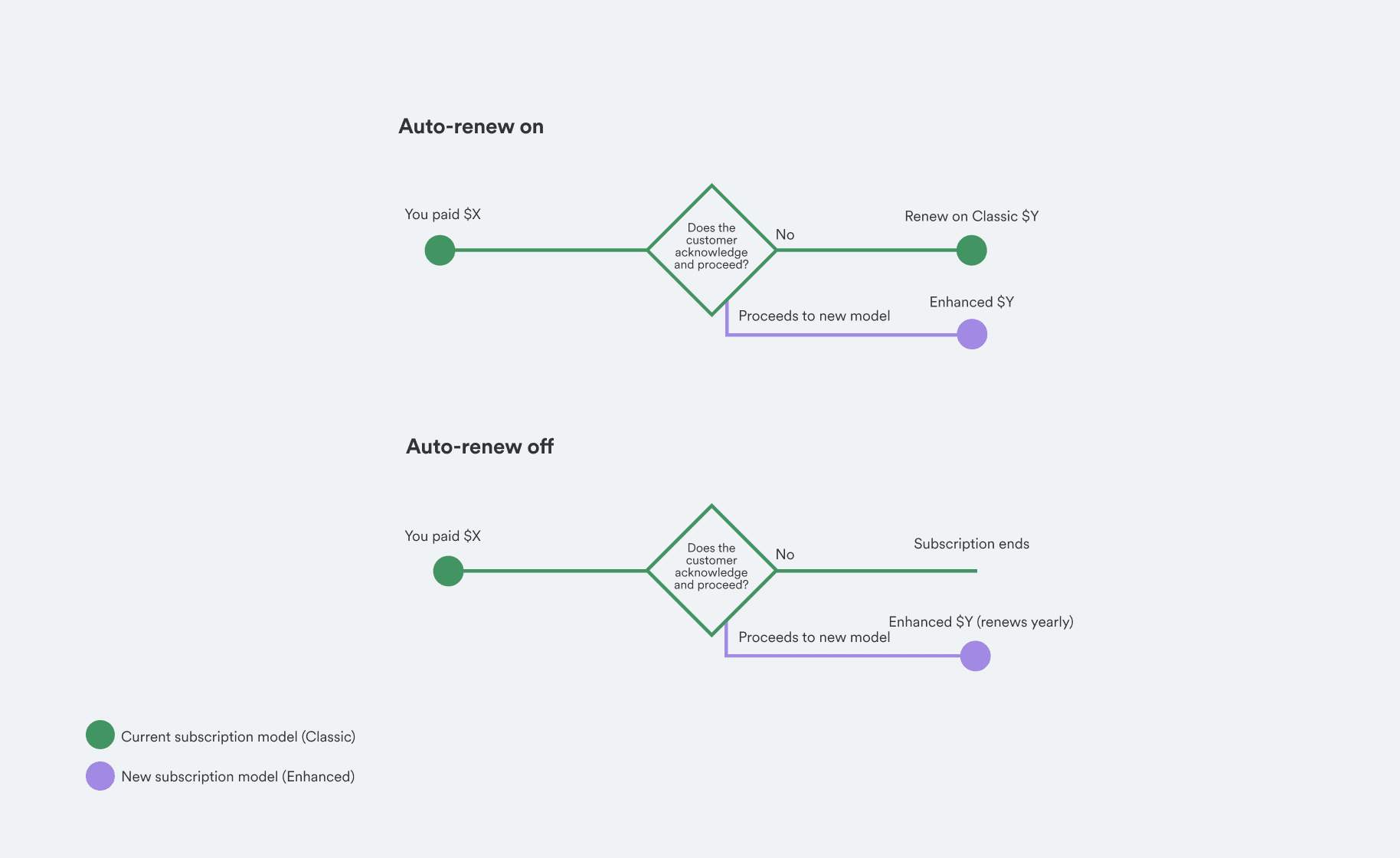
I needed to make the consequences of doing nothing clear, but what Nearmap wanted the customer to do depended on their existing renewal state.
For customers with auto-renew off, we wanted them to actively re-subscribe rather than lose access. For customers with auto-renew on, we wanted them to stay subscribed rather than opt out.
Legal also needed the opt-out to be clear. That left me balancing the commercial goal with making sure customers understood what would happen to their account before they made a decision.
The design needed to work across both states without hiding the opt-out or making the consequences feel more alarming than they were.
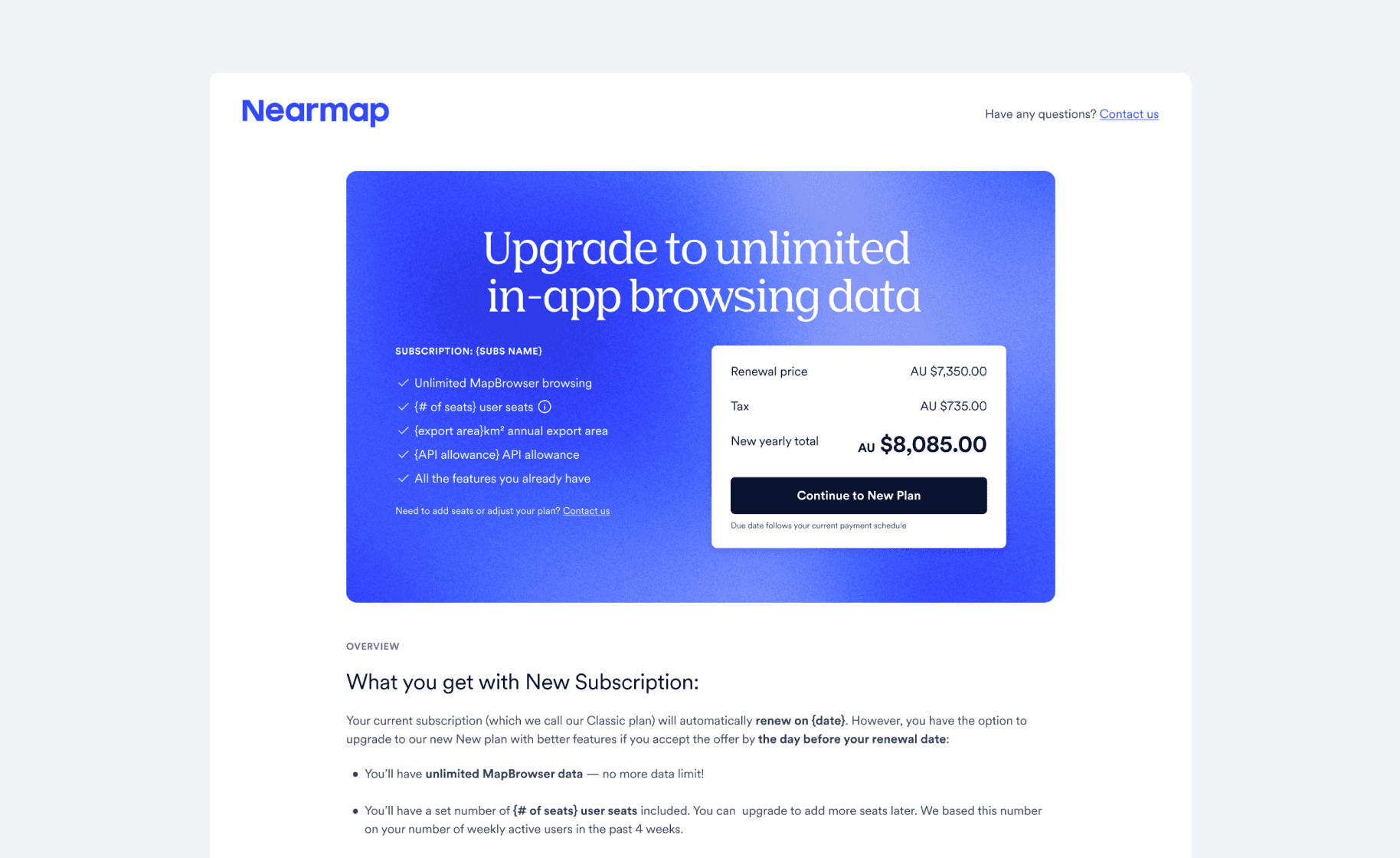
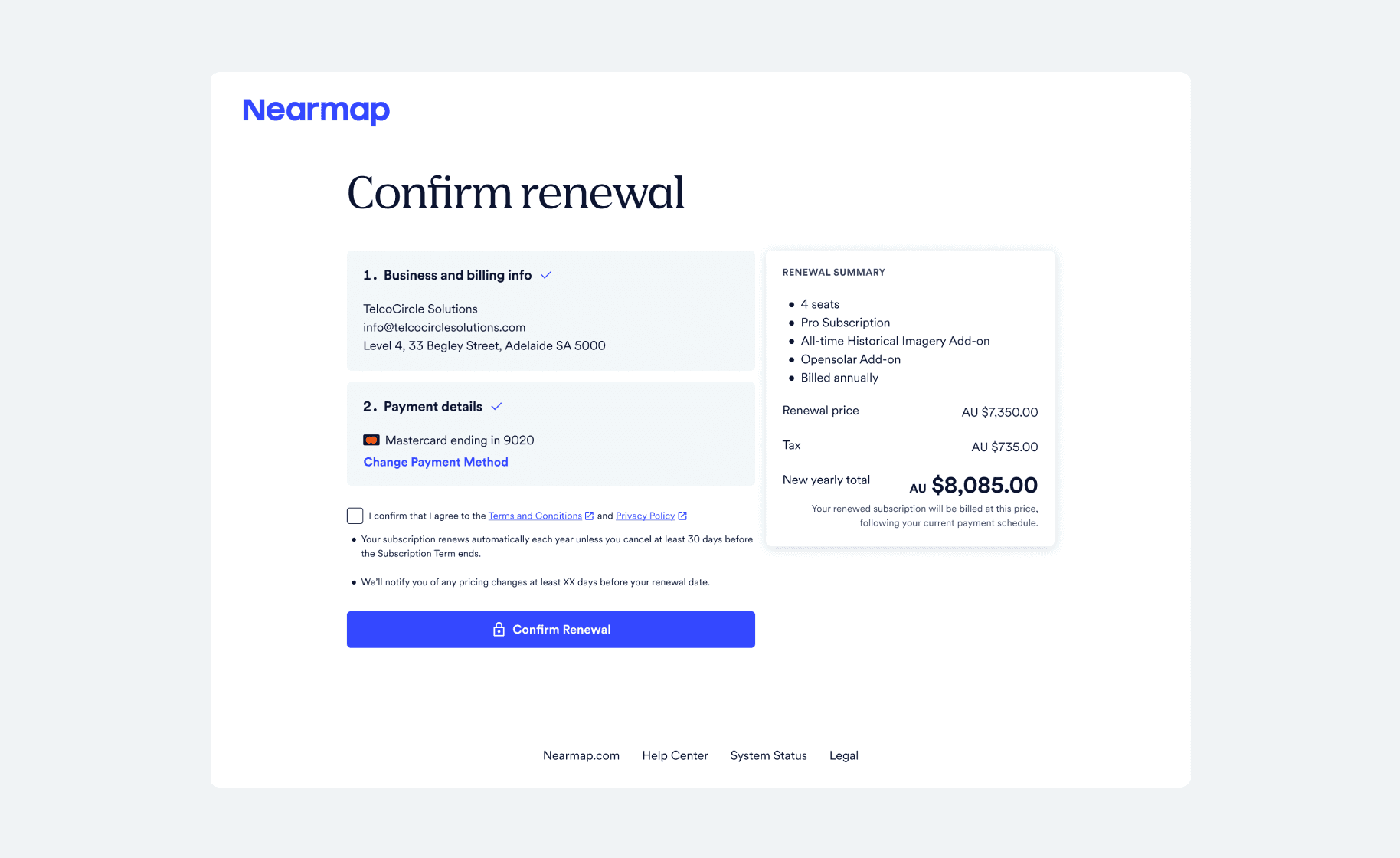
Screens shown are anonymised to respect customer and commercial confidentiality.
Preparing teams before access changed
The new model was seat based. If access wasn’t resolved before the pricing change took effect, people who already used Nearmap could be locked out.
Admins needed to prepare access before that switch, so that they were not scrambling after teams lost it. Pre-seat allocation let admins review who should keep access before the switch, make changes, and undo mistakes. We started from their existing access rather than making them rebuild everything from scratch.
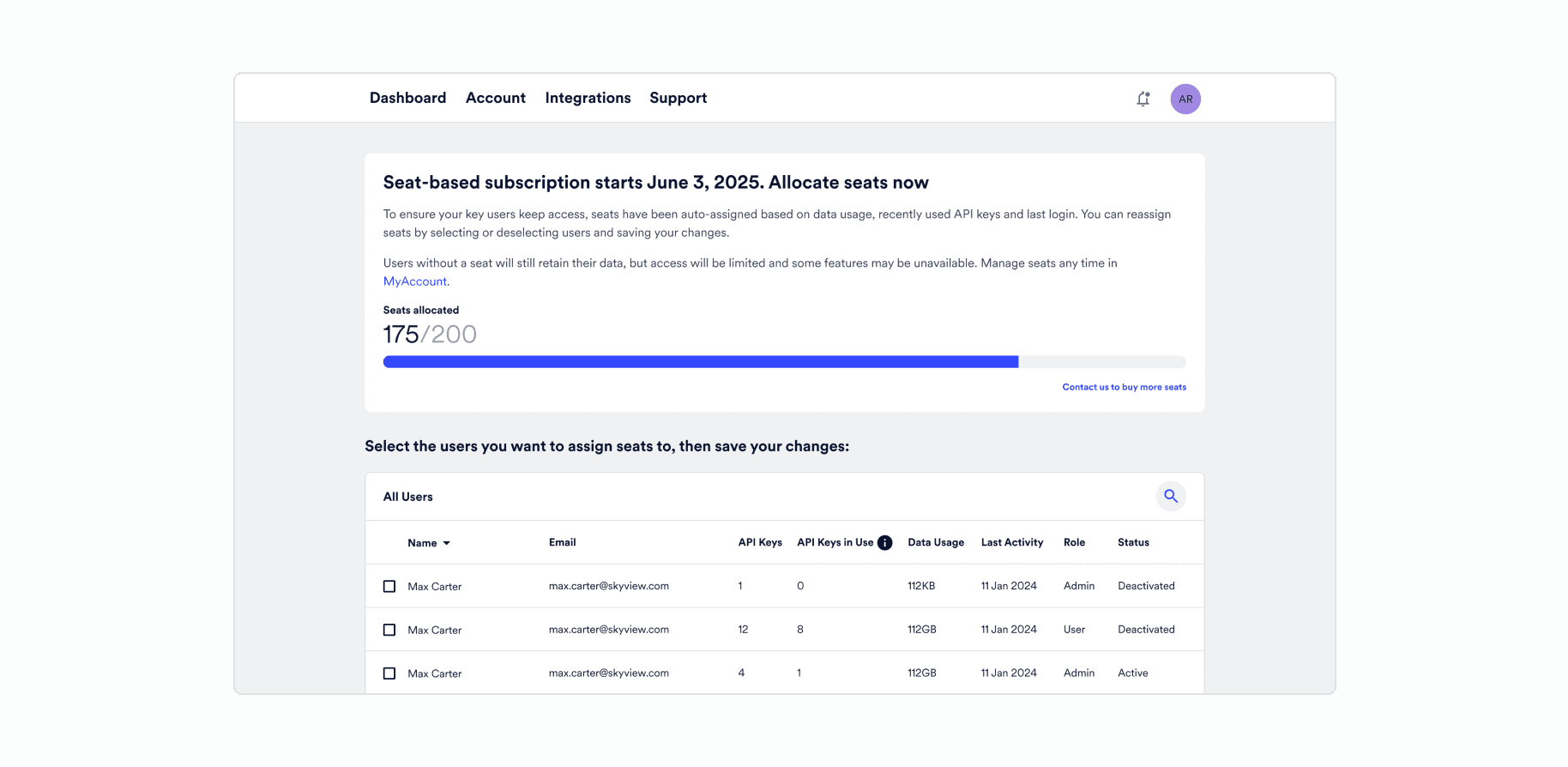
Assisted migration and pre-seat allocation shipped late 2025, while I was still there.
Getting new customers onto the right path
(Not yet launched - in development for 2026)
Not every customer was suitable for self-service.
Some could start immediately while others still needed sales, depending on industry, location, company size, and how messy the need was.
So the experience had to send people down different paths, rather than pushing everyone through one funnel.
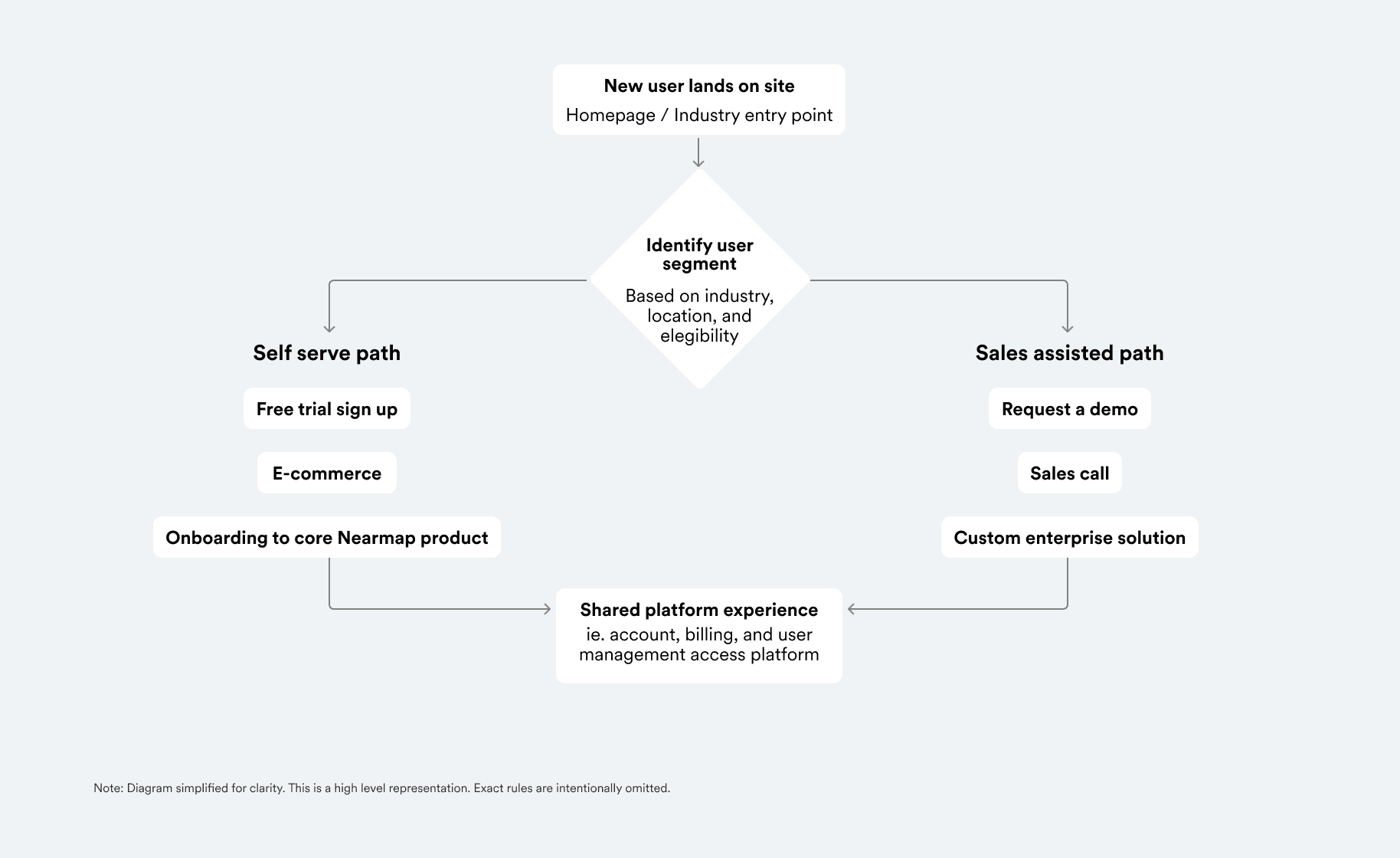
On top of that, the right entry CTA had to appear by region. That meant a two-stage location check (before and after page load), and a fallback when we couldn’t confirm location.
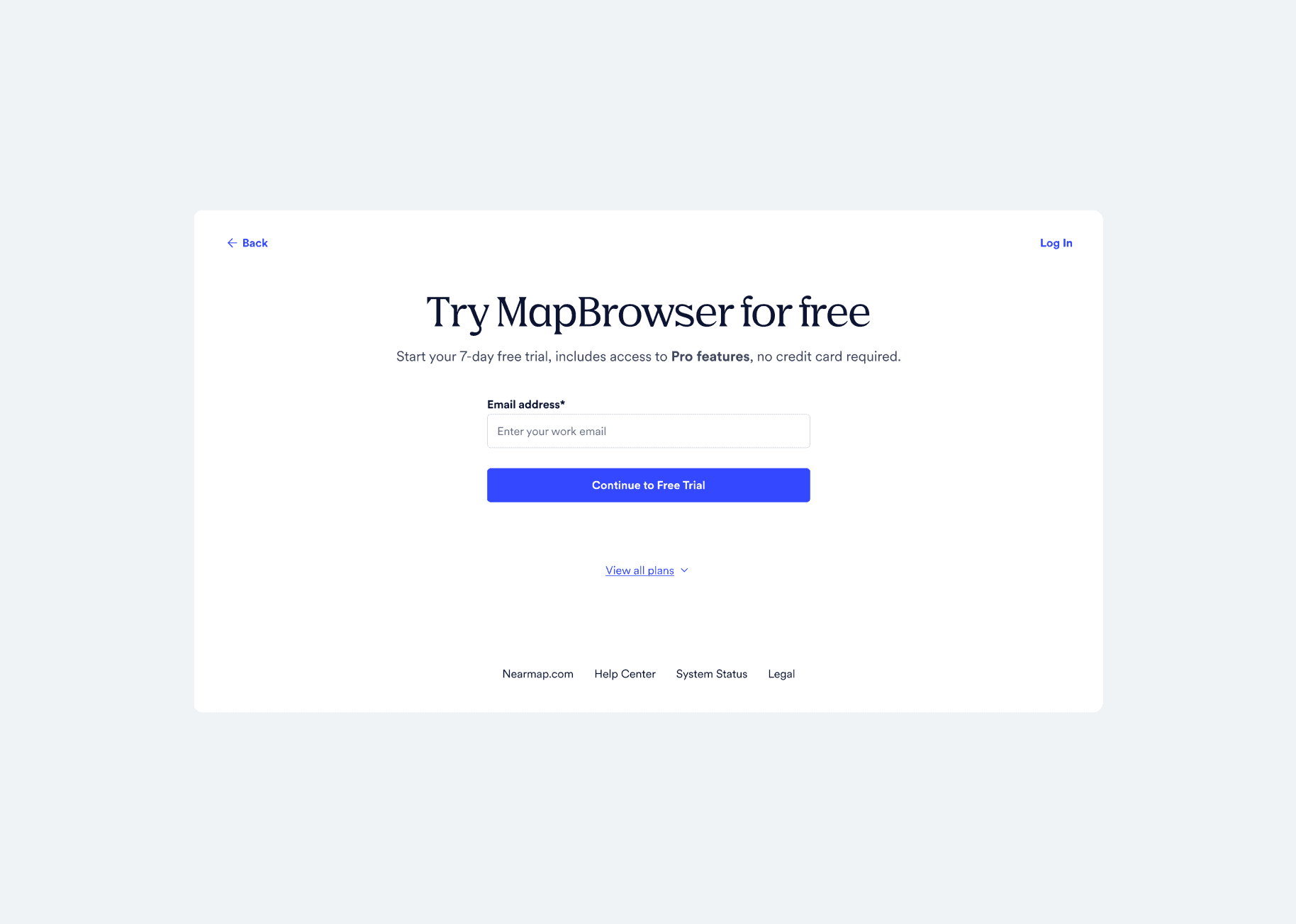
Free trial designs were approved but not live when I left. E-commerce UI is withheld here.
Making evaluation more self-serve
(Shipped, 2024)
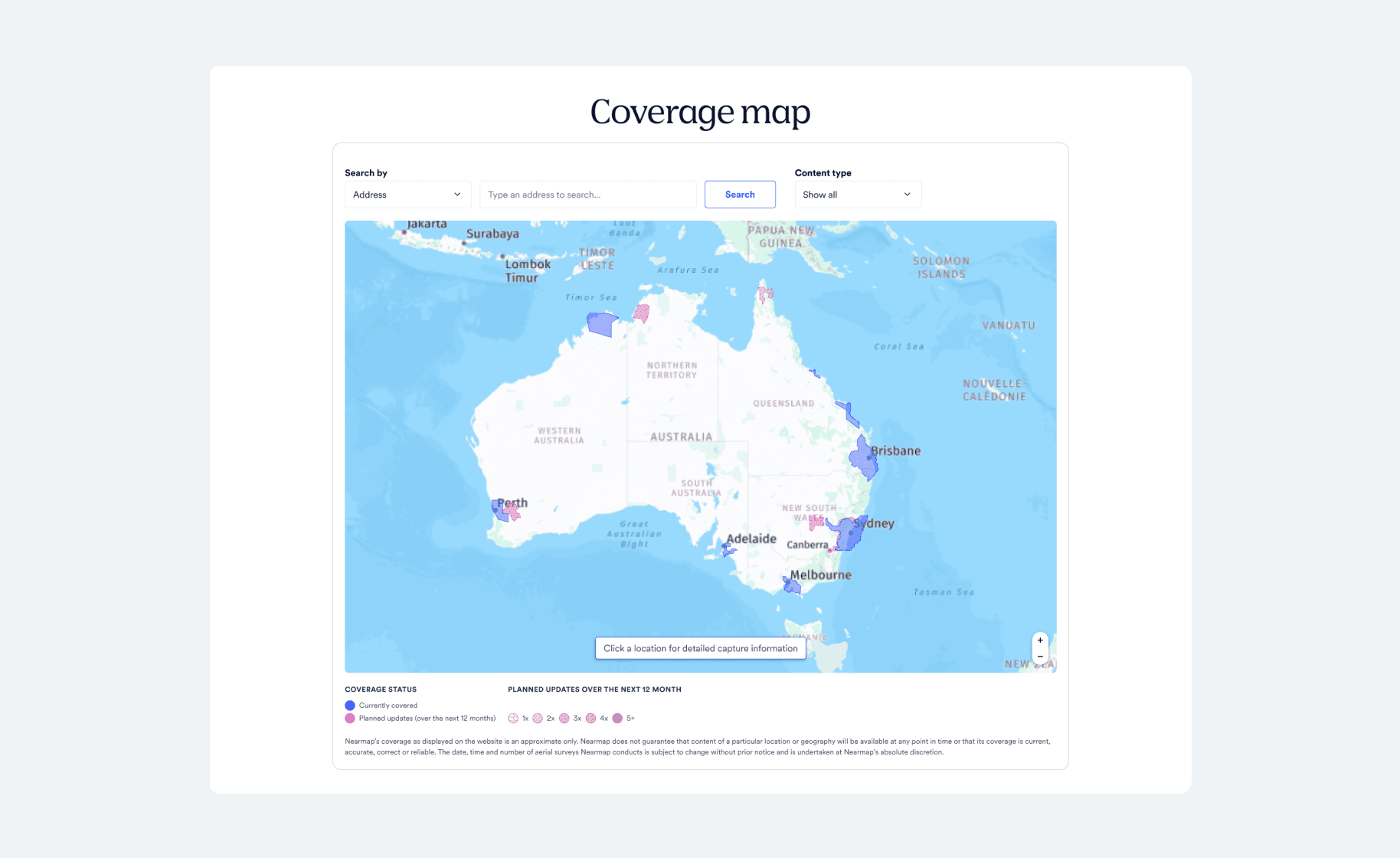
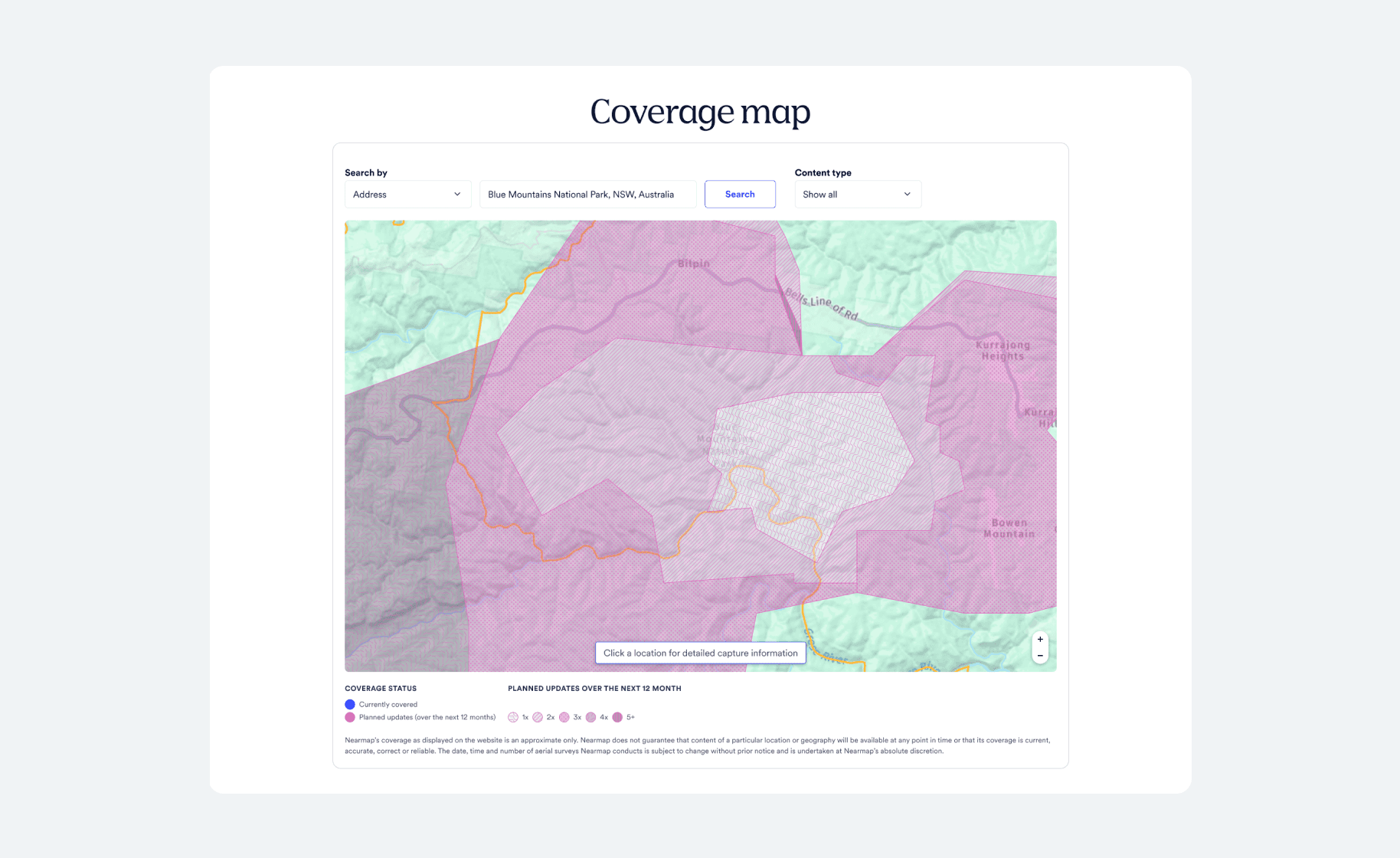
Before any of the subscription work, the coverage map was already one of the most visited surfaces on the site. It was often the first place someone checked whether Nearmap could support their work.
If they couldn’t tell whether an area was covered, or if it would be in the future, there wasn’t much reason for them to keep evaluating Nearmap.
I designed the map so coverage status could be read at a glance: current, planned, and no coverage, plus content types and how recent the imagery was, without having to talk to sales first. The edge cases mattered as much as a clean address search: partial coverage, delayed updates, historical imagery, and searches that don’t resolve to a single pin.
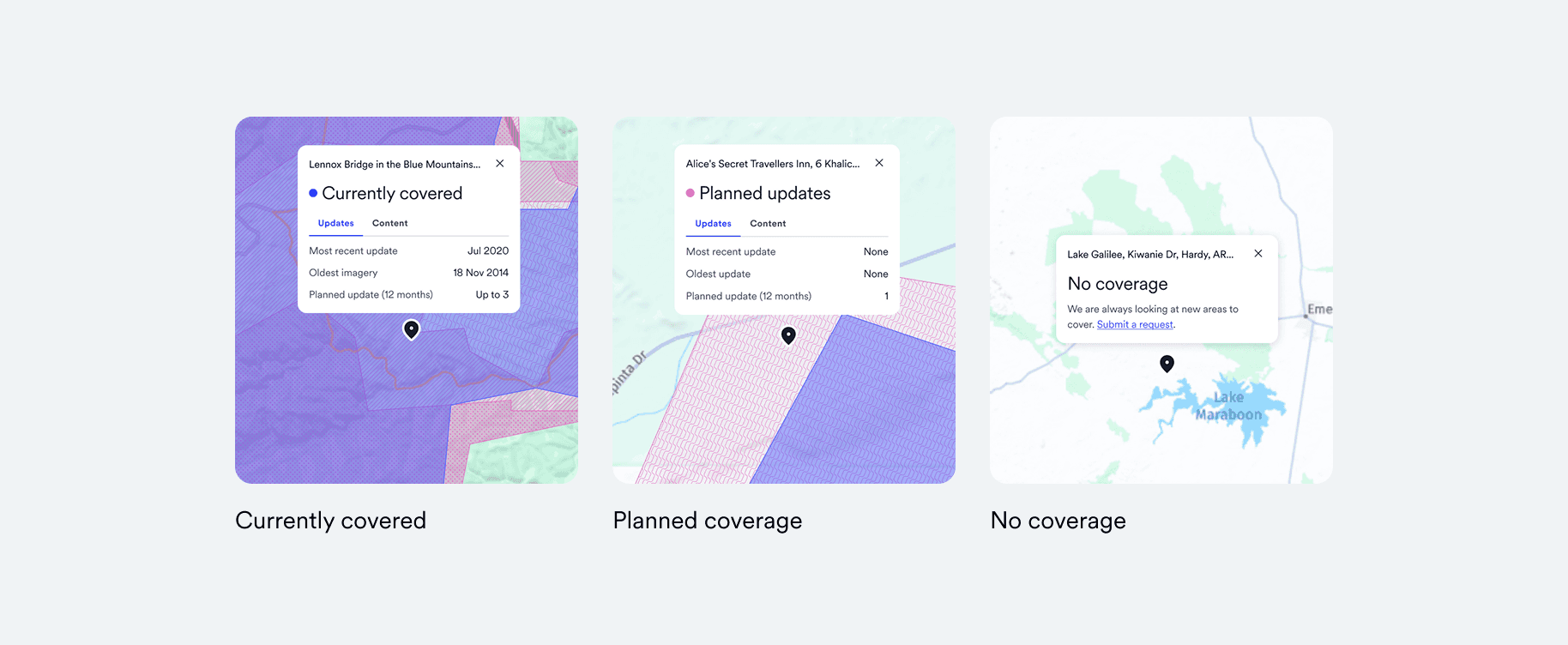
Not all searches resolve to a single point. Searching by region shows coverage at that broader level, without a pin or pop-up.
Status
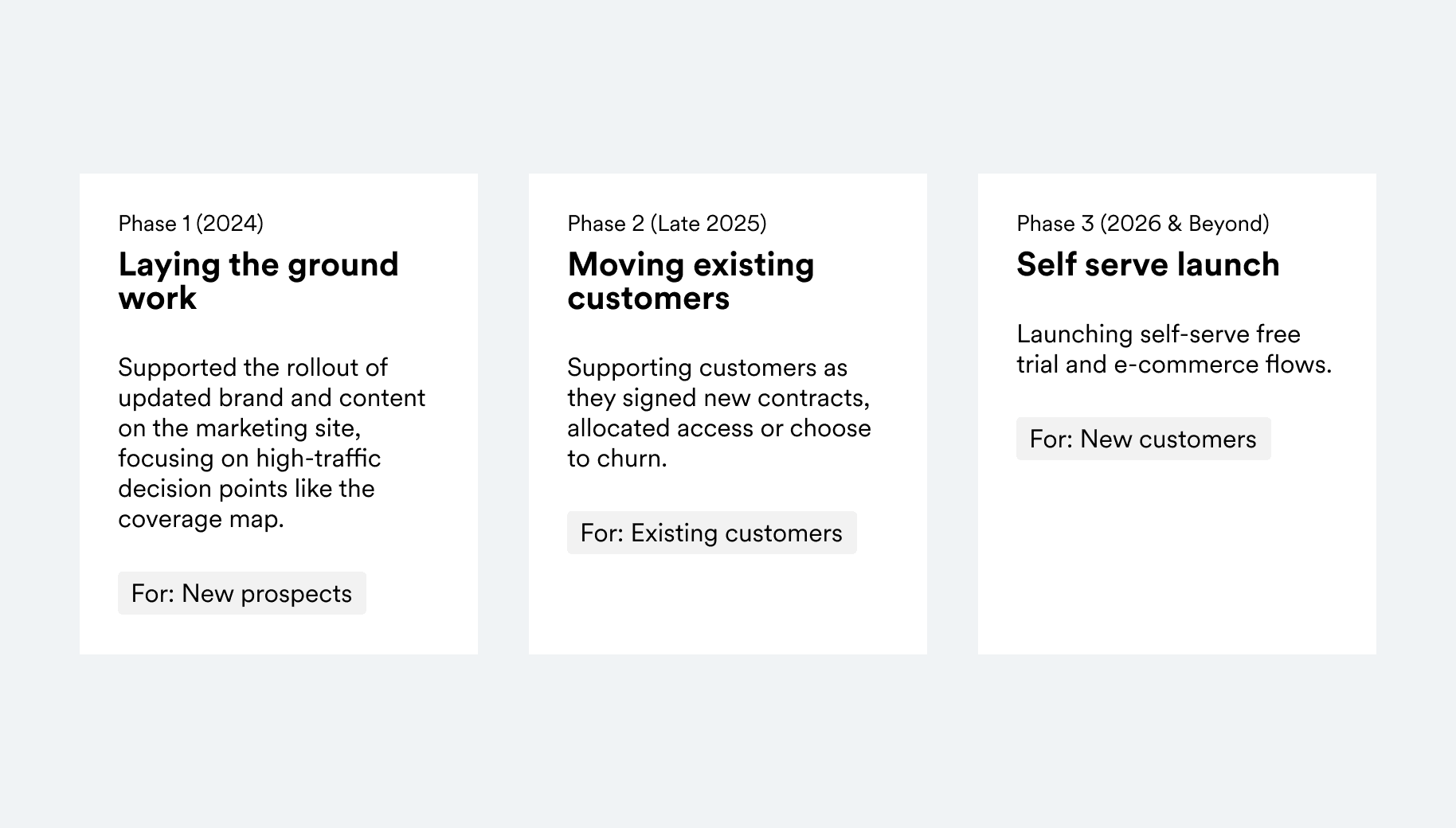
Existing customers were moved first. New customer acquisition came later.
At the time I left:
- Shipped: coverage map (2024); assisted migration and pre-seat allocation (late 2025). No post-launch metrics to share.
- Underway: user management redesign
- Approved, not live: free trial designs
- In development for 2026: new customer entry (self-serve vs sales-assisted)
Some details are omitted because parts of this were still rolling out when I wrote this up.
Reflection
A lot of this work came down to getting the rules straight before getting too far into the design.
Auto-renew on the new subscription model announcement was a good example. The same screen had to account for different renewal states, commercial goals, legal requirements and consequences for access. Once those were mapped out, the design decisions became much easier to make.
That carried through the rest of the subscription work too. With pre-seat allocation, new customer entry and migration, I spent a lot of time finding the edge cases early and working through them with Product and Engineering before they became problems later.